Kimble’s B2B Marketing Fix | Issue 05
What does category leadership actually look like?
It’s not a title you claim. It’s a set of signals you emit. Signals that tell your market:
- You understand the problem better than anyone else
- You’re the one shaping the conversation
- You’re not just in the race — you’re setting the pace
Here are the six signals we use to assess whether a company is truly ready to lead its category. Each one can be measured on a maturity curve: Low. Medium. High.
1. Narrative Ownership
Category leaders don’t just have messaging. They have a story that frames the entire problem space. They define the language. Set the expectations. And shift how buyers think.
Most companies talk about what they do. Category leaders talk about why it matters — in a way only they can.
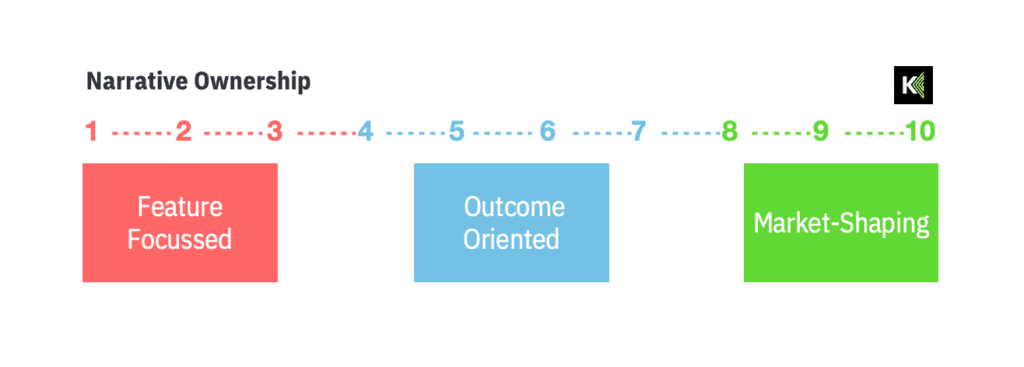
Low: Feature-Focused
- Messaging is feature-led or generic. You’re still explaining what you do.
Medium: Outcome Oriented
- You’ve reframed your offer around outcomes, but your POV isn’t clearly differentiated.
High: Market-Shaping
- Your language shapes how the market defines the problem. Competitors start using your terms.
2. Trusted Ecosystem Presence
No one builds a category alone. To lead, you need alignment with the people who already hold market trust: platforms, media, partners, and communities.
It’s not about collecting logos. It’s about embedding yourself in the channels your buyers already pay attention to.
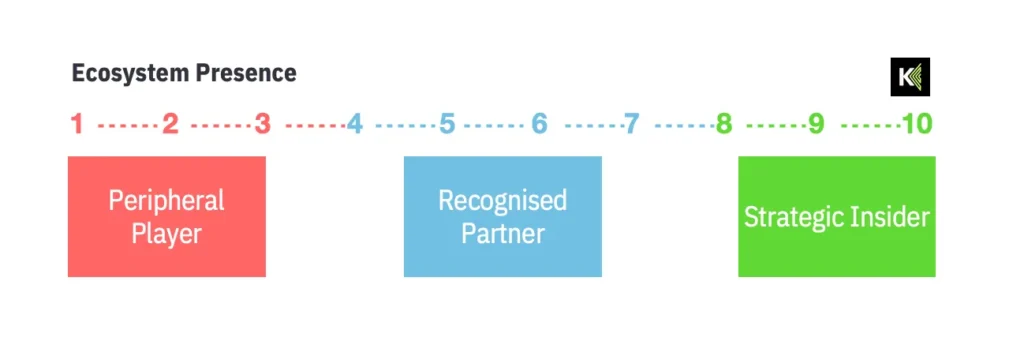
Low: Peripheral Player
- A few integrations or industry mentions, but no real partnership depth.
Medium: Recognised Partner
- You have shared logos and some co-marketing. Recognisable, but not embedded.
High: Strategic Insider
- You’re co-selling, co-pitching, and actively shaping buyer journeys alongside strategic partners.
3. Signal Density
It’s not about being everywhere. It’s about being everywhere that matters.
Your content, your voice, your presence — it shows up across key touchpoints, consistently and deliberately.
The market doesn’t forget you because they never stop seeing you.
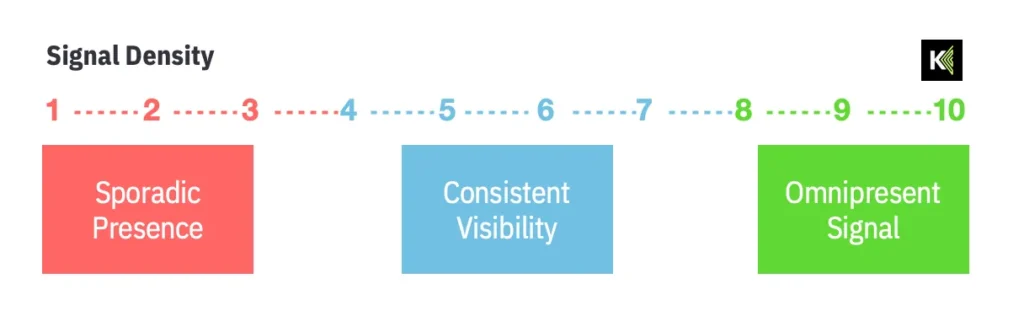
Low: Sporadic Presence
- You post occasionally. People like it, but it doesn’t drive action.
Medium: Consistent Visibility
- You show up regularly, with insight. You’re seen, but not revered.
High: Omnipresent Signal
- You’re the name that keeps surfacing. People say, “I feel like I see you everywhere.”
4. Customer Evangelism
A true category leader doesn’t just have happy customers — they have vocal ones.
When people outside your team start telling your story for you — to peers, to prospects, to press — that’s when you know you’ve crossed a threshold.
Evangelism is the compounding effect of value, trust, and pride.
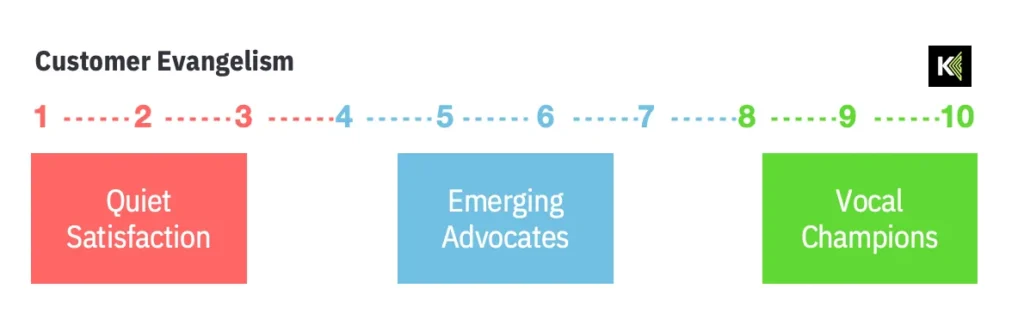
Low: Quiet Satisfaction
- Customers are satisfied, but quiet. Case studies are hard to extract.
Medium: Emerging Advocates
- You’ve got a few champions, but they’re not systematically leveraged.
High: Vocal Champions
- Your customers tell your story for you. They bring you into rooms you haven’t earned access to yet.
5. Conversion Clarity
When your positioning is strong, it shows up in sales.
Prospects come in pre-framed. They understand what you do, why it matters, and how to buy. Sales cycles are cleaner. Objections drop.
Category leaders don’t have to over-explain. Their story does the work.
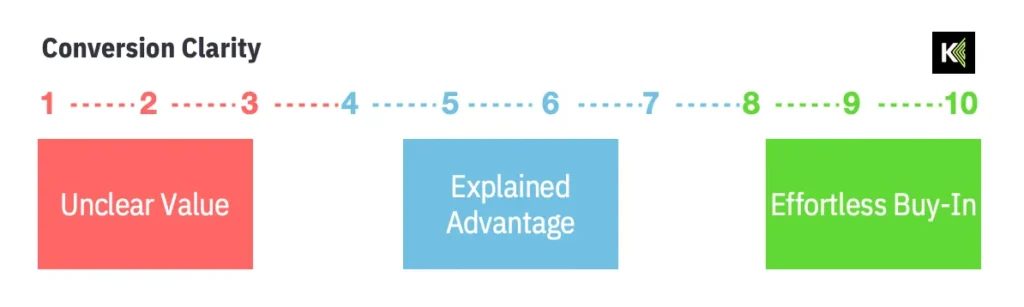
Low: Unclear Value
- Sales cycles are long. Messaging is vague. Content isn’t helping.
Medium: Explained Advantage
- You’re closing, but it takes work. You’re still explaining why you matter.
High: Effortless Buy-In
- You shorten time-to-close because your positioning does the heavy lifting. Prospects come in pre-sold.
6. Influence Infrastructure
Most companies create content. Category leaders build systems of influence.
They know what to publish, when, and where. Their outreach, nurture, events, and messaging are coordinated.
This is how a brand scales authority without scaling chaos.
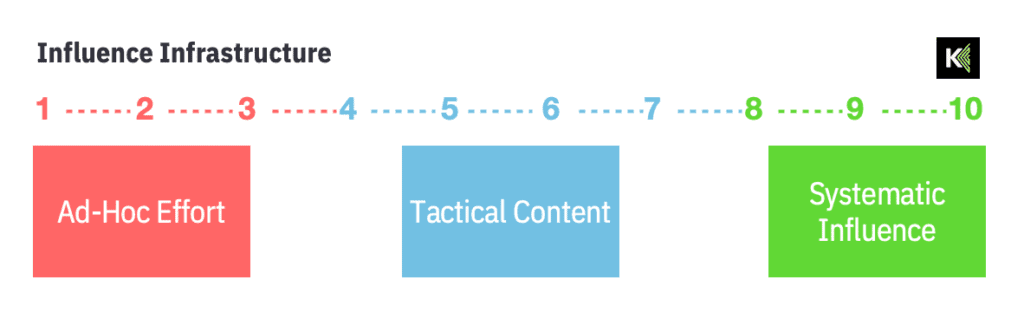
Low: Ad-Hoc Effort
- You have content, but no system. Nurtures are reactive. Events are one-offs.
Medium: Tactical Content
- There’s a strategy, but it’s not tied to the full funnel. Content lacks intentionality.
High: Systematic Influence
- You have a system that builds trust across every stage. Content, events, conversations — all aligned.
Final Thought
Category leadership isn’t about shouting the loudest. It’s about being recognised as the one who leads.
These signals don’t just attract attention. They attract traction — deals, partnerships, and growth.
Category leaders don’t wait to be discovered. They do the work, build the signals, and claim the space they know belongs to them.